





Xiaomi HyperOS 4 (Android 17) Update: Features, Rollout & Upgrade Guide
Xiaomi’s upcoming HyperOS 4 (Android 17) is shaping up to be a major overhaul rather than an incremental update. Leaks and official hints point to a brand-new “Liquid Glass” UI design with a Leica-inspired color palette, interactive lock screen improvements, and deeper AI features. Under the hood, HyperOS 4 embraces a “zero-legacy” architecture core apps are being rewritten in Rust and Flutter, fully removing old MIUI code for better security and performance.
Xiaomi has confirmed a release around July–August 2026 in China, followed by a global rollout (EMEA, India, etc.) starting in Q4 2026. This guide dives into all the new features, device eligibility, comparisons with HyperOS 3/MIUI, regional rollout details, upgrade tips, and more.
Key New Features in HyperOS 4
UI Overhaul: Liquid Glass Design & Leica Theme
Xiaomi’s HyperOS 4 promises a dramatic visual refresh. Leaks (via tipsters like Digital Chat Station) confirm a Liquid Glass UI with transparent, glossy overlays, fluid animations and advanced bounce effects. The interface will sport a modern, cohesive look, aligning with Android 17’s own “Liquid Glass” direction. Xiaomi is also deepening its Leica partnership: app icons, shadows, highlights and even system sounds will draw on a Leica-inspired color palette for a premium aesthetic.
HyperOS 4 may add an interactive Lock Screen Island (as requested by users) and customizable home-screen widgets. All system animations (100+ animations in HyperOS 3) will be even smoother, thanks to the new Flutter-based UI framework and optimized graphics rendering.
Performance & Architecture: Rust, Flutter, and Efficiency
Under the surface, HyperOS 4 is a “zero-legacy” rewrite. Xiaomi has removed all old MIUI code (“zero-legacy”), rewriting core system apps and frameworks in Rust for memory-safe, modular architecture. The new codebase means faster system updates and security patches, reduced memory usage, and smoother performance especially on mid-range devices. Boot times and app launch speeds should improve, and animation stutters will be noticeably reduced. Early benchmarks suggest HyperOS 4 could deliver higher frame rates in graphics and games, building on Android 17’s optimizations.
Privacy & Security Enhancements
Privacy is a big focus. HyperOS 4 reportedly gains a software-based privacy display that narrows the viewing angle to thwart “shoulder-surfing” all in software without extra hardware. Xiaomi’s security core will benefit from the Rust rewrite: eliminating legacy code means fewer vulnerabilities and faster patching. Expect strengthened permission controls and data encryption. Xiaomi’s Secure Privacy Framework will be expanded: it “significantly enhances connectivity across devices while keeping personal data secure”.
AI & Assistant Features
Following global Android trends, HyperOS 4 will deepen on-device AI integration. Android 17 adds smarter multitasking and AI workflows, and Xiaomi will layer its own HyperAI suite on top. We anticipate more AI-powered productivity tools (like the “DeepThink” note-taking and on-device text summarization introduced in HyperOS 3).
The OS will integrate better with large-language models (e.g. Gemini) for live translation, transcription, and context-aware search. For example, users might get “AI Translator” in the dialer (translating calls in real time) or picture-based search that identifies objects from the camera. These are evolutionary from HyperOS 3’s capabilities but built on Android 17’s new AI APIs.
Multitasking & Connectivity
HyperOS 4 improves multitasking, especially across screens and devices. Expect enhancements like the “Sidebar” (floating app drawer) and better split-screen support on tablets and foldables. Cross-device connectivity (HyperConnect) will grow: sharing files and screens with PCs/iPads or unlocking multiple devices seamlessly.
New large-screen modes and smarter background task management will help in multitasking. Xiaomi hints at smarter cross-device continuity: for example, you might drag an app window from a phone to an adjacent tablet screen. Gaming mode is also expected to get improvements, given Xiaomi’s focus on performance.
Battery & Optimization
Though Android 17 brings its own battery improvements (better idle management, etc.), HyperOS 4 adds Xiaomi’s optimizations on top. The leaner codebase and aggressive background-task pruning should improve battery life, especially on older hardware. Leak reports specifically mention “better battery optimization” in HyperOS 4.
Fast charging and reverse charging features remain, but the new OS may allow dynamic refresh rate control and power-saving modes to work even more efficiently.
Camera & Multimedia
While HyperOS 4 isn’t a camera software update per se, the Leica partnership hints at subtle camera UI tweaks. The Leica color science now could influence photo/video processing and gallery display, making colors appear more natural. Users might see new camera app themes or preview effects reflecting Leica’s style. Meanwhile, media playback should benefit from Android 17’s codec support (like AV1) and possibly more advanced audio enhancements. We might also see a revamped Gallery app, building on HyperOS 3’s redesigned Gallery.
Developer & System Changes
For developers, HyperOS 4 means the end of MIUI SDK constraints. Xiaomi’s move to Rust/Flutter means native apps and third-party apps can benefit from a more consistent framework and APIs. The OS will still support standard Android app development (Kotlin/Java), but system modules are now Rust/Flutter. New developer options may appear, like easier toggling of the privacy screen or advanced caching controls. Xiaomi’s HyperOS Downloader will likely support HyperOS 4 builds. Bootloader unlocking procedures should remain similar HyperOS is still Android at its core.
Finally, app compatibility should be high: HyperOS 4 is still Android 17, so most apps (including banking, games, etc.) that work on Android 16/17 will run. Xiaomi is reportedly testing core banking and game apps on HyperOS 4 to ensure support. If an app misbehaves, Xiaomi will push fixes quickly via updates.
HyperOS 4 vs. HyperOS 3 / MIUI – Feature Comparison
The table below summarizes how HyperOS 4 differs from previous versions (HyperOS 3 is Android 16-based; MIUI 14 was the last MIUI version on Android 13):
| Feature / Area | MIUI 14 (Android 13) | HyperOS 3 (Android 16) | HyperOS 4 (Android 17) |
|---|---|---|---|
| Codebase | Traditional Java/MIUI framework | Partially refactored; still contains MIUI legacy code | Zero-legacy: All core apps refactored in Rust/Flutter |
| UI Design | Flat design, color themes (MIUI style) | New icons, smoother animations, HyperIsland lock screen | Liquid Glass transparent UI, Leica color theme |
| Privacy/Security | Standard Android privacy features + MIUI | Improved privacy (HyperOS audit, protected computing) | Narrow-angle privacy display, Rust memory safety |
| Performance | Good on flagship (Android 13 optimizations) | Faster animations, refined graphics; some bloat remaining | Faster boot/apps; modular updates; reduced RAM use |
| Battery Life | Decent, MIUI’s optimizations | Good with Battery Boost (game focus) | Better OS efficiency (Android 17 power management) |
| Animations/Graphics | MIUI animations (smooth but heavy) | +100 refined animations, stable rendering | Ultra-fluid (bounce physics, adjustable blur)** |
| Lock Screen | Widgets, security & notifications | HyperIsland notification island, dynamic wallpapers | Enhanced Island; intelligent sorting of widgets and notifications |
| AI/Assistant | Mi AI (basic integration, Alexa/Celadon) | DeepThink notes, AI write, translations | Expanded on-device AI (LLM integration, live translation) |
| Multitasking | Standard split-screen, floating windows | Sidebar, floating window enhancements | Improved cross-device multi-window, smarter splits, 5- to 9-view windows for tablets |
| Connectivity | Xiaomi Share (files with Xiaomi devices) | HyperConnect (Apple device sharing, home+ iPad) | Even broader (Cast fitness stats, cross-ecosystem unlocking) |
| Updates | MIUI patched weekly or monthly | Similar cadence; global beta program | Faster patches possible (smaller, modular updates) |
This comparison shows HyperOS 4 builds on HyperOS 3’s foundations but with a more ambitious overhaul essentially a new OS shell for Xiaomi.
Supported Devices & Rollout Schedule
Xiaomi has not published a final list, but leaks and update policies indicate dozens of Xiaomi, Redmi, and POCO models will get HyperOS 4 (Android 17). Eligible devices range from flagships (Xiaomi 17/15/14 series, Mix Flip, etc.) to popular mid-rangers (Redmi Note 15 series, Redmi K90 series/POCO F8 Ultra) and even some budget/entry phones (Redmi A7/A5). For example, the first Chinese HyperOS 4 beta is expected on Xiaomi 17 series and Redmi K90/POCO F8 Ultra models.
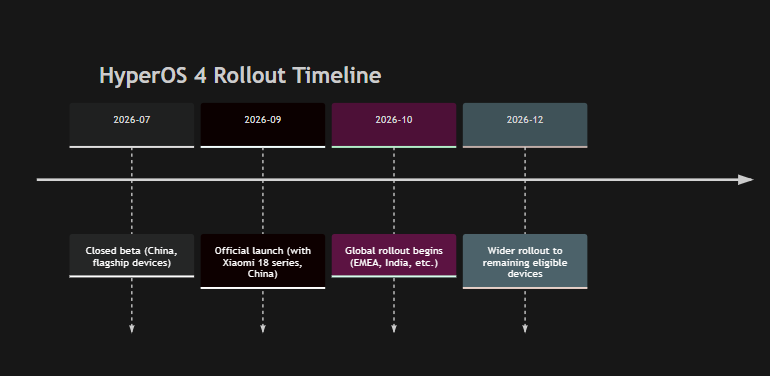
Rollout Timeline (leaked): Xiaomi is targeting a China launch in late Q3 2026. Closed beta testing may begin as early as July–August in China, followed by an official HyperOS 4 debut alongside the Xiaomi 18 series. Global launch often trails China by a few weeks: HyperOS 3 launched in China in August 2025 and internationally in September. Analysts project HyperOS 4 global rollouts for October–December 2026.
Regional Notes: As usual, Xiaomi follows a China-first strategy for software. New updates and bug fixes typically appear first in Chinese ROMs and later in global/Indian/EU ROMs. This means Chinese models (sometimes called “CN ROM”) may get HyperOS 4 weeks earlier than international versions. India (where Xiaomi ships Mi and Redmi devices) will see HyperOS 4 as part of the global MIUI (HyperOS) updates, likely in lockstep with Europe. Latin America releases can lag a bit due to carrier testing.
In the US, Xiaomi’s presence is limited (e.g. Xiaomi 15 on T-Mobile); those unlocked models will follow the global timeline. Note that Chinese HyperOS 4 will include China-specific features and services (no Google apps, different app store, multi-user mode), whereas the global version will have Google services and typically no multi-user. Carriers usually have few Xiaomi phones, so most updates will go to unlocked devices.
Upgrading to HyperOS 4: Checklist & Tips
When the HyperOS 4 OTA arrives for your model, follow these steps for a safe upgrade:
- Backup your data: Use Mi Cloud or Google Drive to back up photos, contacts, messages, etc. You can also use the built-in “Backup” app to save settings locally.
- Charge & Connect: Ensure the phone has ≥50% battery and is on a stable Wi-Fi network. Updates can be several gigabytes.
- Free up space: Remove unused apps or transfer files if storage is low.
- Install OTA Safely: Go to Settings → About phone → System update and download the HyperOS 4 update. Xiaomi’s updater will guide you. Do not interrupt the installation once started.
- Post-update Checks: After reboot, confirm your apps work (especially banking apps). Check settings for any new permissions (privacy display, AI features) and re-enable any disabled settings. If you had gesture/navigation customizations, reapply them if needed.
- Troubleshooting: If you encounter issues, Xiaomi’s forums and XDA threads often have fixes. For example, on HyperOS 3 some users solved 60Hz lock issues by clearing a system app’s data. Always report bugs via Settings → Feedback to help Xiaomi patch them.
User-Reported Issues & Fixes
Since HyperOS 4 is in beta as of mid-2026, real-world feedback is limited. However, Xiaomi’s track record with HyperOS updates provides clues. For HyperOS 3, users reported bugs like Wi-Fi reconnection prompts, gallery glitches (duplicate or mismatched thumbnails), and game mode resets. Xiaomi quickly addressed these: a May 2026 bug report shows fixes for Wi-Fi login loops, gallery duplicate media, Game Turbo resets, and other stability issues.
For HyperOS 4, expect initial teething problems in early betas. Common complaints might include unexpected reboots or app compatibility hiccups. Xiaomi’s community moderators advise waiting for stable global builds before reporting major issues. Historically, fixes for HyperOS (and MIUI) issues appear first in Chinese beta patches and later roll into international updates. In other words, many HyperOS 3 fixes “filtered down” to global users over weeks.
Some HyperOS 3 fixes (e.g. camera lag, launcher icon issues) already rolled out in minor updates, suggesting Xiaomi is attentive. We anticipate similar rapid patches for HyperOS 4: for instance, if HyperOS 4’s liquid animations cause performance dips, expect a follow-up update to optimize them. Keep an eye on official Xiaomi forums, XDA and Reddit communities; fellow users often share workarounds (like clearing a particular app’s cache) until an official fix arrives.
Impact on Popular Xiaomi Models
Below is a summary of how HyperOS 4 will affect key Xiaomi devices:
| Model | Expected Update Timing | Key Benefits |
|---|---|---|
| Xiaomi 17 / 17 Ultra / 17T Series | China: Q3 2026; Global: Q4 2026 | Full HyperOS 4 features (UI redesign, Rust security, AI). Maximum performance and camera optimizations. |
| Xiaomi 15 / 15 Pro / 15 Ultra | China: Q3 2026; Global: Q4 2026 | Major UI and OS overhaul, longer update support. Faster animations, better battery life. |
| Xiaomi 14 / 14 Pro | China: Q3 2026; Global: Q4 2026 | All key HyperOS 4 upgrades (UI, AI features, privacy). Improved gaming and camera processing. |
| Xiaomi Mix Flip / Foldables | China: Q3 2026; Global: Late 2026 | Enhanced multi-screen multitasking, productivity boosts. New tablet-like multitasking (split 1:9). |
| Redmi K90 Pro Max (POCO F8 Ultra) | China: Q3 2026; Global: Q4 2026 | Gaming optimizations (Game Turbo fixes), UI overhaul, better thermal management. |
| Redmi Note 15 Pro / 15 / A-series | China: Q4 2026; Global: Late Q4 2026 | Performance and battery improvements. New interactive widgets and privacy features. |
| POCO X8 Pro / POCO F7 / etc. | China: Q4 2026; Global: Late Q4 2026 | Similar benefits to Redmi devices (since internals match). May have POCO-specific UI themes. |
In general, flagship models (17/15 series) will receive the update first, with the new design and full feature set. Mid-range devices (Note series, K-series) will follow, gaining most benefits except perhaps some premium animations (if hardware-limited). Entry-level models (Redmi A series) will get a trimmed-down HyperOS 4 focused on stability and battery life. After the update, even older devices will feel snappier and gain new privacy/AI tools that they didn’t have on MIUI.
FAQ
Q1: What is HyperOS 4 and when will it be released?
A: HyperOS 4 is Xiaomi’s next major OS update, based on Android 17. It’s expected to be officially unveiled in China around July–September 2026 (likely with the Xiaomi 18 series) and roll out globally in late 2026.
Q2: Which Xiaomi/Redmi/POCO phones will get HyperOS 4?
A: Most recent Xiaomi flagships and many mid-range models will get HyperOS 4. This includes Xiaomi 17/15/14 series, Mix Flip, Redmi Note 15 series, Redmi K90 (POCO F8), and select budget models like Redmi A7. Check official Xiaomi forums for an updated eligibility list, but if your phone gets Android 17, it will almost certainly get HyperOS 4.
Q3: What are the biggest new features in HyperOS 4?
A: Key new features include a refreshed Liquid Glass UI with Leica-inspired colors, an interactive lock screen island, and more fluid animations. Under the hood, HyperOS 4 removes all old MIUI code (Rust-based core apps) for better security and efficiency. It also adds stronger privacy (a software privacy screen), improved battery and performance, and deeper AI/assistant tools (on-device translation, summarization, etc.).
Q4: How is HyperOS 4 different from MIUI or HyperOS 3?
A: Unlike MIUI 14 or HyperOS 3, HyperOS 4 is essentially a ground-up rewrite with no legacy MIUI code. The UI is redesigned (glass-like transparency vs. MIUI’s flat look), and many core apps are now written in Rust/Flutter. You’ll notice much smoother animations, a smarter lock screen, and new features (privacy display, cross-device AI) that were not in MIUI. In short, HyperOS 4 is positioned as a completely new OS experience rather than an iterative MIUI update.
Q5: How do I prepare for and install the HyperOS 4 update?
A: Before updating, back up your data (use Mi Cloud or local backup) and ensure you have enough free storage and battery. When HyperOS 4 arrives via Settings → About Phone → System Update, download and install it carefully. After reboot, verify that all your apps till work. If issues arise, check Xiaomi’s official forums and wait for any quick bug-fix patches.